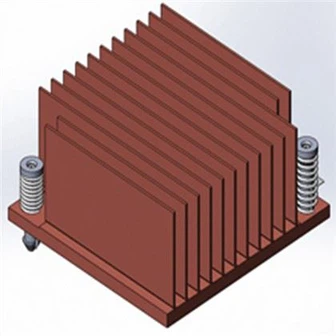
Три ефективні методи тепловідведення силових модулів
There are three basic methods for power module energy transfer from high temperature area to low temperature area: radiation, transmission and convection.
Radiation:
The electromagnetic induction transfer of heat generated between two blocks of different temperatures.
Transmission:
The transfer of heat generation through a solid medium.
Convection:
The transfer of heat through a fluid medium (gas).
In a variety of specific applications, all three methods of heat transfer often have different levels of effect. In most applications, convection is the most critical heat transfer method. If the other two heat dissipation methods are added, the actual effect will be better. However, in some situations, these two methods may also have counterproductive effects. Therefore, when designing a high-quality heat dissipation system, all three heat transfer methods are carefully considered.

power module
1, radiation source, heat dissipation
When two interfaces with different temperatures face each other, it will cause continuous radiation transfer of heat.
The final influence of radiation on the temperature of certain blocks is determined by many factors: the temperature difference of various components, the orientation of related components, the smoothness of the surface of the components and their mutual spacing, etc.
Because there is no way to quantitatively analyze this element, plus the influence of the surrounding environment's own radiative kinetic energy exchange, it is very complicated to measure the harm of radiation to temperature, and it is difficult to accurately calculate.
In the specific application of the switching power converter control module, it is unlikely to rely solely on radiant heat dissipation as the cooling method of the converter.
In most cases, the radiant source only dissipates 10 percent or less of the total heat generation. Therefore, radiant heat is generally only used as an auxiliary method in addition to the key heat dissipation method, and it is generally not considered in the thermal design plan. The influence of the temperature of the power supply module. In specific applications, the temperature of the general converter control module is higher than the natural ambient temperature. Therefore, the radiant kinetic energy transfer is conducive to heat dissipation. However, under some conditions, the temperature of some heat sources (electronic device boards, high-power resistors, etc.) around the control module is higher than the temperature of the power module, and the radiant heat of these objects will increase the temperature of the control module.
In the heat dissipation design plan, the relative positions of the peripheral components of the converter control module should be arranged scientifically according to the influence that the heat radiation will cause. When the hot components are close to the converter control module, in order to weaken the heating effect of the radiation source, the thin fins of the heat insulation board should be inserted between the control module and the hot components.
2, transmission heat dissipation
In many applications, the heat generated on the power module substrate must be transferred to a long heat dissipation surface through heat transfer components. That way, the temperature of the power module substrate will be equivalent to the sum of the temperature of the heat dissipation surface, the temperature of the heat transfer components, and the temperature of both surfaces.
The thermal resistance of the heat transfer components is proportional to the length L between the two, and inversely proportional to the cross-sectional area and heat transfer rate between the two. The use of appropriate raw materials and cross-sectional areas can also effectively reduce the thermal resistance of the heat transfer components. When installation space and cost are allowed, the radiator with the least thermal resistance should be used. It should be kept in mind that if the substrate temperature of the power module decreases slightly, the mean time between failures (MTBF) will increase significantly.
The raw materials for the production of heat sinks are a key element that affects efficiency, so you must pay attention to many aspects when selecting. In most applications, the heat generated by the power module will be transferred from the substrate to the heat sink or heat transfer components. However, there will be a temperature difference on the surface between the power module substrate and the heat transfer components. This type of temperature difference must be controlled.
The thermal resistance is connected in series in the heat dissipation control loop. The temperature of the substrate should be the surface temperature and the heat transfer components. The sum of the temperature. If it is not controlled, the temperature rise of the surface will be very obvious. The total surface area should be as large as possible, and the smoothness of the surface should be within 5 mils (0.005 feet). In order to better remove the unevenness of the surface, you can fill the surface with thermal conductive glue or heat transfer pad. ) After taking appropriate countermeasures, the surface thermal resistance can be reduced to below 0.1 degree /W. Only by reducing the heat dissipation thermal resistance (RTH) or reducing the power consumption (Ploss) can the temperature be reduced and the TAmax can be increased.
The maximum power of the switching power supply is related to the temperature of the application scene. The main parameters that affect the output power loss Ploss, thermal resistance RTH and the highest switching power supply Case temperature TC. The switching power supply with high efficiency and best heat dissipation will have a lower temperature. When the nominal output power is output, their usable temperature will be marginal. The temperature of a switching power supply with lower efficiency or weak heat dissipation will be higher. They must be air-cooled or derated applications.
3, convection heat dissipation
Convection heat dissipation is the most commonly used heat dissipation method for Aipu power converters. Convection is generally divided into natural convection and forced convection. The transfer of heat from the surface of the hot block to the surrounding static gas at a lower temperature is called natural convection; the transfer of heat from the surface of the hot block to the fluid gas is called forced convection. The advantages of natural convection are that it is very easy to implement, does not require electric fans, is low in cost, and has high reliability in heat dissipation. However, in contrast to forced convection, in order to achieve the same substrate temperature, a large heat sink is required.
Natural convection radiator design should also pay attention to the following:
Generally, only the main parameters of vertical heat sinks are given for heat sinks. The actual heat dissipation effect of the horizontal heat sink is weak. If horizontal installation is required, the area of the radiator should be increased appropriately, and forced convection heat dissipation can also be used.